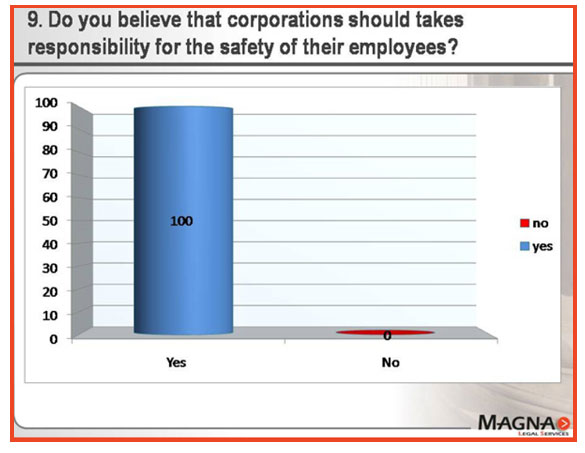
| Panelists in our focus group study responded to a number of pre-stimulus questions designed to find out whether they were predisposed to any beliefs which could influence their reaction to information heard in the study. For example, fully 100% of the panelists said they believe that corporations should take responsibility for the safety of their employees:
All panelists said they believe an injury or health problem due to exposure to harmful substances might not manifest itself immediately but could develop over a long period.

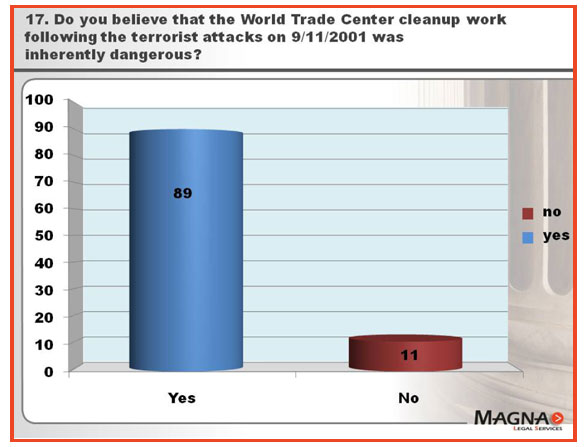
Nearly all of the panelists believe that World Trade Center cleanup work was "inherently dangerous."
And nearly all of the panelists agreed that WTC cleanup workers exposed to dust and debris there would later develop health problems as a result.
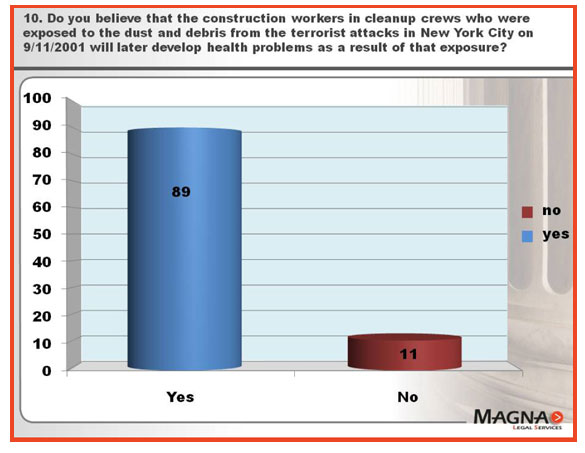
Thus, panelists entered into the presentation with fairly strong fixed beliefs that corporations should take responsibility for employee safety, that exposure to harmful substances could take a long time to trigger illness, that Trade Center cleanup work was inherently dangerous and that WTC cleanup workers exposed to dust and debris at the site would likely develop serious health problems as a result.
The panelists in this exercise described powerful memories of September 11th, 2001, where they were and what they felt. They recalled a stark contrast between the beautiful morning and the fear and tragedy into which it devolved. Some vividly described the horrific stench, a taste and smell in the air that hung over lower Manhattan in the weeks following the attacks.
Interestingly, the panelists' responses to questions regarding the events of that day did not differ significantly before and after they were exposed to the stimulus or presentation, including several still and video images of the plane collisions, tower collapses, debris and clouds of smoke and dust covering lower Manhattan. Again, this suggests the "oversaturation" has created a desensitizing of the jurors. Following this presentation, which described in detail the post-collapse conditions, panelists' memories of that day included more references to the plume of dust and smoke but, overall, the subjects actually reported less anger over the events of September 11th after viewing the presentation. Several panelists expressed that today, their strongest emotional response to the September 11th attacks is not anger or fear, but sadness.
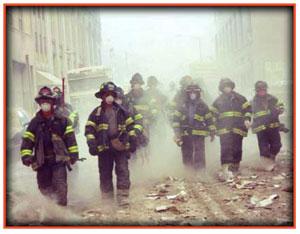 Significantly, before hearing the presentation eight out of nine group members, and all members after the presentation, believed that the first responders and cleanup workers who were exposed to dust and debris from the World Trade Center collapses would later develop health problems as a result. All panelists agreed that such problems would not necessarily manifest themselves right away but might take years to develop. Following the presentation, which emphasized the magnitude of the dust and wreckage that blanketed lower Manhattan, and identified many of the hazardous materials contained in the debris, all panelists readily accepted that the air and environment at and near Ground Zero were dangerous. Many panelists said they knew the WTC towers had been constructed using asbestos, which they recognized to be hazardous, and also recalled wondering a bout the harmful chemicals in the air at the collapse site.
The panelists did not doubt that both first responders and cleanup workers at the site were exposed to various harmful substances that would likely lead to serious injury or death. Opinions varied, however, as to whether that exposure was simply "a part of the job," whether such exposure could have been prevented and whose responsibility it was to warn or protect emergency and non-emergency workers against such exposure. The panelists' opinions on these questions seemed to hinge on when the work was performed (i.e., during the emergency rescue and recovery phase versus the nonemergency cleanup phase) and who was performing it (i.e., trained emergency personnel, such as firefighters, versus untrained manual laborers, such as construction/ cleanup workers or volunteers).
Participant reaction in this study suggests how their views on different types of workers were split: Trained Emergency Workers versus Untrained Non-emergency Workers
JOB RESPONSIBILITY
"Just part of the job:" Panelists were more likely to feel that exposure to harmful dust and debris was simply a part of the emergency first responders' jobs, as such occupations frequently require the workers to accept the risk of serious injury or death in the immediate pursuit of rescue and recovery.
"NOT part of the job:" Panelists were less likely to believe that exposure to hazardous chemicals was a part of the non-emergency cleanup workers' jobs, as this type of work should not be inherently dangerous.
AVOIDABILITY OF EXPOSURE
Exposure was Unavoidable During the Emergency Phase: Due to the emergent nature of the first responders' work in rescuing potential survivors from the rubble of the collapsed WTC towers, most panelists acknowledged that exposure to hazardous dust, smoke and debris was inevitable and could not be avoided in the early stages of recovery. Others countered that, due to first responders' training and knowledge of hazardous materials, they especially should and could have taken the time necessary to put on protective gear, such as masks.
Exposure was Preventable Later: Since the urgency of the situation had dissipated by the time cleanup work got underway, panelists argued that there was enough time and means for appropriate safety precautions to be taken before such work began. Specifically, cleanup workers should have been outfitted with adequate protective gear, such as masks and/or hazmat suits, not just ineffective paper masks, before they entered their work sites.
PERSONAL VERSUS GOVERNMENTAL RESPONSIBILITY
Emergency Workers Bore Some Personal Responsibility for Safety: Panelists inferred that first responders on September 11th would have been trained professionals, such as firefighters and police. They reasoned that some of the responsibility to avoid exposure to hazardous materials fell on the first responders themselves. Subjects felt they should have known of the dangers before they entered the site. Panelists felt that heroic firefighters willingly placed personal safety at risk, and that chemical exposure and long-term health consequences were not in the forefront of the emergency workers' minds while they were engaged in rescue efforts. But panelists also felt that of all the workers who came to the site, the first responders should have been the most conscious of health risks and the most careful about protecting themselves from the dust and debris. With that in mind, however, some panelists still believed that the government had a responsibility to protect the safety of those first responders. If emergency personnel were not concerned about protecting themselves from harmful chemicals in the air at the time, the government should have been there to enforce appropriate safety measures, regardless of the immediacy of the situation.
Government Bore Greater Responsibility for Cleanup Worker Safety: Because the panelists assumed that most of the cleanup workers would have been untrained to deal with hazardous conditions such as existed at Ground Zero, they felt that these workers and their employers should not have been held responsible for their own safety on the work sites. Rather, the panelists felt that the government was responsible for informing and warning employers and workers about the potential dangers and health risks present in the area, as well as for insuring that they were provided with appropriate protective gear before beginning any work on potentially hazardous sites.
Panelists expressed anger toward the government, particularly the Environmental Protection Agency (EPA), for its poor handling of safety issues at Ground Zero. Many felt that the state and federal governments seemed more concerned with the reopening of Wall Street and the business of lower Manhattan (which incredibly reopened in 6 days) than the safety and health of the citizens working to clear the area, and that they should have been more concerned with the latter. At least one panelist recalled EPA Director Christie Whitman's statement that the air in lower Manhattan was "safe to breathe" only one week after the attacks, when reports from those working and living in the area revealed that buildings had not been cleaned and that hazardous chemicals hung in the air. The panelists felt that the government either refused or failed to monitor the safety of the area and make sure workers had needed protective gear.
 The panelists were reluctant to hold employers of cleanup workers' responsible for protecting them from the hazardous chemicals in the air at job sites because the government had failed to warn the employers of the potential dangers for their employees and declared the air safe to breathe. Many panelists felt that the government should have monitored the safety of such sites for private employers, and that employers should have been able to rely upon the accuracy of government representations about air quality.
The group did agree, however, that employers should hire skilled workers with the appropriate training to work in potentially hazardous conditions. If a business hired a remediation company to clean its building after the attacks, the group expected the remediation company to supply trained workers who were knowledgeable about the dangers of such work and to outfit them all necessary protective gear. However, if the business itself acted to hired unskilled laborers or employees to do the cleanup work on its building, the panelists believed that the business should absolutely be held accountable for the safety and health concerns of those workers.
If an employer fails to provide its workers with adequate protection, then it would be responsible for any subsequent health problems the workers developed as a result of their exposure to hazardous chemicals. This falls directly in line with the jurors' responses and beliefs captured during the pre-stimulus questioning.
| 





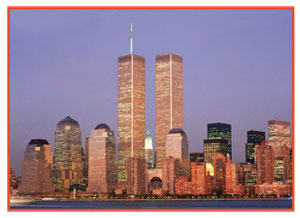 Can anyone remember where they were on April 14, 1865? Of course not, since anyone reading this article would not have been alive. If you were, however, you would remember it as the day that Abraham Lincoln was assassinated. Americans likely learned about the incident days later through the newspaper or early telegraph technology.
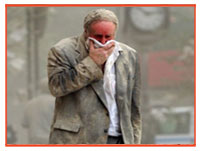 Before jurors were presented with any information as to why or what type of focus group they were going to participate in, they were asked to answer a series of pre-stimulus questions. During the focus group, we presented participants with a summary of the events of the attacks in New York, including video and photographic images of the strikes on the towers, their fall and detailed information about what was contained in the debris, including asbestos, toxins, heavy metals and hazardous chemicals. The group was educated about the "Toxic Cocktail" faced not only by firefighters and emergency workers, but also by the many tradespeople, heavy equipment operators, laborers and ordinary cleanup workers who followed to clear debris after the immediate emergency passed. Then the group members answered a series of questions, and discussed at length their reactions to the attacks and to possible injury claims from workers, who were often unprotected by "hazmat" gear and who believe exposure to the debris has caused them to become ill.
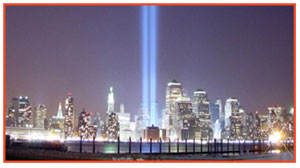 In conducting this research study, we confirmed some expectations but also identified some surprising reactions to the aftermath of September 11th. New Yorkers react with a strong sense of sadness, instead of anger, to these events. They believe another attack is imminent and do not feel safe, but are getting on with their lives. They have a feeling of helplessness and inability to control past events or prevent future danger. Our research participants were in some sense "false experts": while they knew conditions were bad and held enough awareness about science to recognize some of the potential long term medical risks, they lacked detailed knowledge regarding the extent or "Toxic Cocktail" consisting of "four million pounds of asbestos" mixed with many known hazardous chemicals.